For decades, technological innovation has been driven by a simple promise: make life easier, faster and more efficient. From smart thermostats to connected fridges, digital technologies increasingly help us optimise our daily lives. But what if we have been asking the wrong question?
Instead of asking how technology can become smarter, perhaps we should ask how it can become more careful.
This is the central idea behind our recent paper, Careful Configurations: An Exploration of Smart Technologies in More-than-Human Innovation. Rather than viewing technology as a collection of intelligent devices, we explore how innovation might strengthen the relationships between people, neighbours, materials, animals and the environments we share.
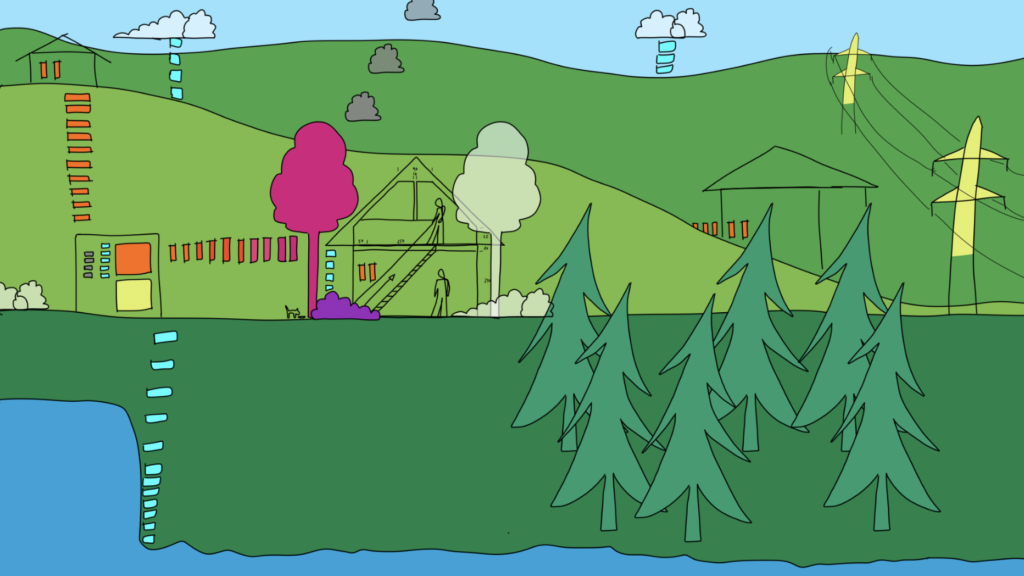
Seeing What Is Usually Invisible
Many technologies focus on solving individual problems. A smart thermostat learns your heating preferences. A smart fridge monitors your groceries. A fitness watch counts your steps. Useful? Certainly.
But these devices rarely understand the wider ecology in which we live. They cannot recognise the value of a neighbour sharing surplus heat, the social importance of walking instead of driving, or how local ecosystems quietly support everyday life.
Our research suggests that sustainable innovation begins by making these relationships visible.
Learning from Everyday Life
The paper draws on a series of small experiments carried out during the construction and everyday inhabitation of a house.
Some were surprisingly simple:
- using winter temperatures as a natural refrigerator instead of running an electric fridge;
- carrying heat stored in chamotte stones from a wood-fired stove into cooler rooms;
- observing how chickens unexpectedly resolved a long-standing neighbourhood dispute over a broken fence;
- exploring how parts of a house might seasonally become “inside” or “outside” rather than permanently heated.
None of these examples relied on sophisticated artificial intelligence. Instead, they depended on careful observation, cooperation and an awareness of relationships that already existed.
From Smart Devices to Careful Configurations
The article also imagines future technologies that do not simply automate our homes but help communities care for one another.
Imagine a neighbourhood display showing which homes have surplus warmth and which households need heating. Instead of buying more energy, neighbours could exchange heat stored in reusable thermal stones.
Or a village hydration map that visualises soil moisture and water availability, helping residents coordinate water use during droughts.
Or a community dashboard that makes visible not only human needs but also the wellbeing of trees, soils, pollinators and local wildlife, allowing communities to respond collectively rather than individually.
These are not proposals for more surveillance. They are invitations to think differently about what technology is for.
Rethinking Innovation
Traditional models of innovation balance three familiar questions:
- Is it desirable?
- Is it technically feasible?
- Is it commercially viable?
Our paper proposes an alternative.
Instead of focusing only on human desire, technological possibility and economic growth, we suggest thinking in terms of:
- Relational Desire – what relationships need in order to flourish.
- Resourceful Value – creating value from existing resources rather than extracting new ones.
- Careful Configurations – arranging technologies, materials and communities so that multiple forms of life can thrive together.
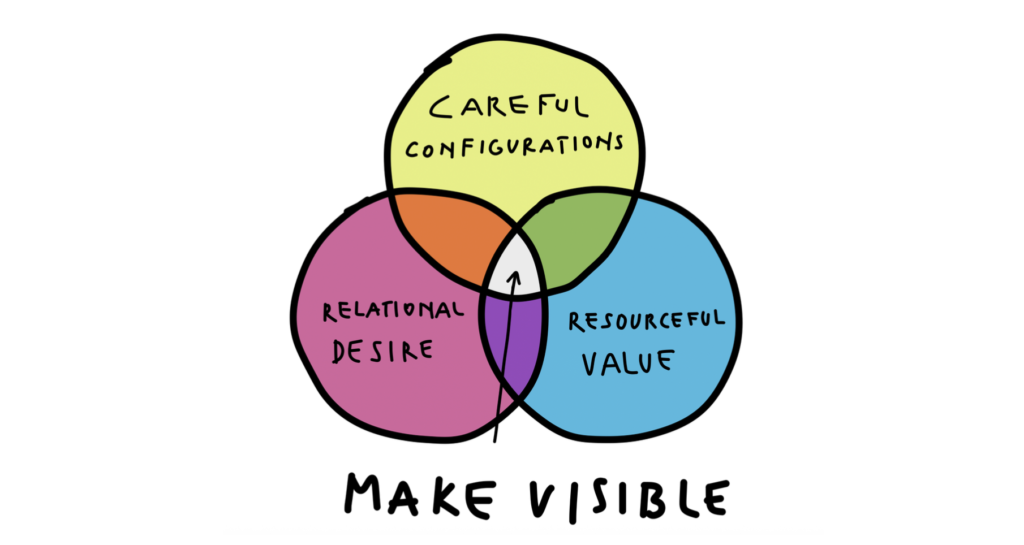
Innovation, in this sense, is no longer about producing smarter products. It becomes the ongoing practice of making relationships visible and carefully reconfiguring them.
Perhaps the most sustainable technology is not the one that automates our lives, but the one that helps us notice the people, places and living systems that have been supporting us all along.
Reference
Neubauer, R., & Fuchsberger, V. (2026). Careful Configurations: An Exploration of Smart Technologies in More-than-Human Innovation. Proceedings of the Design Research Society Conference 2026. https://doi.org/10.21606/drs.2026.2279