How might design research change when nature is no longer treated as a backdrop, but as an active participant in inquiry?
This question brought together researchers and participants for the Festival of Postdigital Wilds, hosted by the Neudorf Institute for Innovation in collaboration with New Design University and Kunstuniversität Linz. Over a weekend, participants transformed the Institute’s rural grounds into a temporary living laboratory where research, everyday life and ecological relationships became inseparable.
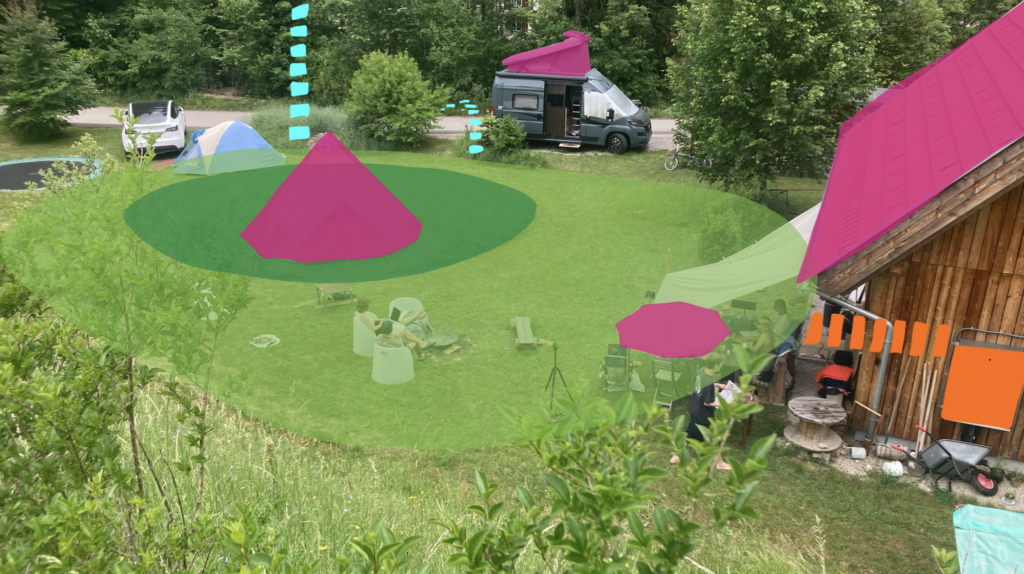
The event unfolded through shared living. Participants camped on site, prepared communal meals, carried out observations, built experimental prototypes and reflected together on what it means to design with nature rather than simply for it. The gathering itself became part of the research process, revealing how everyday practices, technologies and environments continuously shape one another.
Throughout the festival, attention shifted between the visible and the often overlooked infrastructures that make collective life possible. Broadband connections, electrical systems, tables, tents, kitchen routines, compost bins and recycling stations became just as important as plants, insects and weather conditions. Rather than separating the digital from the ecological, participants explored how contemporary life is configured through their ongoing entanglement.
Several design experiments investigated how technologies might support new forms of attention. One project used a Raspberry Pi camera to document the slow movements of cucumber plants over time, encouraging participants to observe subtle environmental changes that would otherwise remain unnoticed. The project became a starting point for discussions about perception, technology and more-than-human perspectives.
The festival also revealed that living together is rarely without tensions. Questions emerged around the use of shared spaces, the organisation of work, and the competing needs of people, plants and animals. Everyday situations—from storing cameras on communal tables to protecting cucumber plants from slugs—became opportunities to reflect on the complexity of care. Rather than presenting care as a simple ethical principle, these encounters highlighted the negotiations and compromises that accompany every act of living together.
For the participating students, the Festival of Postdigital Wilds offered an opportunity to experience design research beyond the studio. Observation, making, cooking, maintaining infrastructures, discussing ideas and caring for shared spaces all became part of the research process. The boundaries between fieldwork, everyday life and design practice dissolved into a shared exploration of more-than-human co-living.
The festival forms part of an ongoing research programme investigating eco-social innovation, relational design and everyday practices. It demonstrates how temporary living laboratories can create opportunities to explore new forms of collaboration between humans, technologies and the wider ecological systems within which they are embedded.